


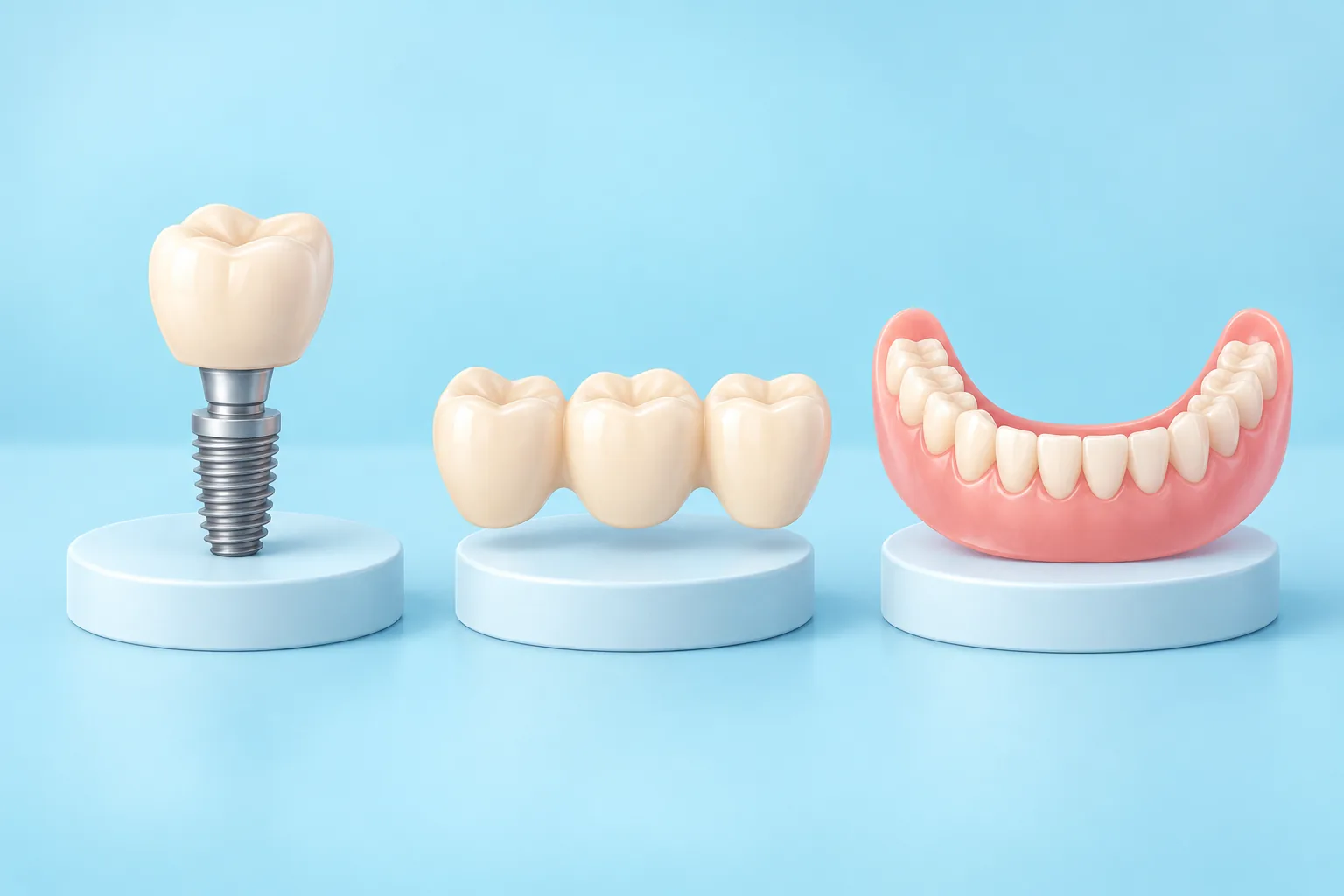
A missing tooth can be replaced in three main ways: with a dental implant, a bridge or a removable denture. A bridge or a denture can also be supported by implants. Each option works differently, and each one suits a different situation. People lose teeth for many reasons, and some of them are described in our article on common reasons for tooth loss.
The right option depends on your remaining teeth, jawbone and general health. The number of missing teeth also matters. No option is the best one for everyone. The dentist recommends a solution after an examination and a 3D scan (CBCT).
Three ways to replace a missing tooth
A dental implant replaces the root of the tooth. It is a small screw that the surgeon places in the jawbone. Over several months the implant fuses with the bone. Dentists call this process osseointegration. A crown is attached to the implant through a connector called an abutment. The dentist decides when the crown can be fitted.
A conventional bridge on natural teeth replaces one or more missing teeth in a row. The artificial tooth is attached to crowns on the teeth on each side of the gap. These supporting teeth are called abutment teeth. A fixed bridge stays in the mouth, and only a dentist can remove it.
A removable denture is a set of artificial teeth that you take out of your mouth for cleaning. A partial denture replaces some teeth and clips onto the teeth you still have. A full denture replaces all the teeth in one jaw.
Restorations on implants combine both ideas. A bridge can be fixed on implants instead of natural teeth. A removable denture can clip onto several implants, so it holds better than a regular denture.
The table below shows how the options differ in general. Your own plan may differ, because it depends on your teeth and bone.
| Comparison | Implant with a crown | Bridge on natural teeth | Removable denture | Denture or bridge on implants |
|---|---|---|---|---|
| What holds it | Implant in the jawbone | Crowns on the neighbouring teeth | Gums, and clasps on remaining teeth for a partial denture | Several implants in the jawbone |
| Can you take it out | No | No | Yes | A denture on implants clips on and off. A bridge on implants is fixed |
| Neighbouring teeth | Not changed | Shaped to hold crowns | A partial denture may use them for support. Some teeth may need preparation | Not changed |
| Surgery | Yes, to place the implant | Usually not needed to fit the bridge | Usually not needed to fit the denture | Yes, to place the implants |
| Jawbone | Enough bone is needed. Bone grafting may be added | Supported by teeth. The shape of the gum and bone can affect the design | The denture rests on the gums. As the bone changes, the denture can become loose | Enough bone is needed for each implant |
| Treatment time | Healing is part of the plan. Timing depends on the case | The dentist confirms the steps after examination | The dentist confirms the steps after examination | Healing is part of the plan. Timing depends on the case |
| Daily care | Brushing, flossing and visits to the hygienist | Cleaning under the bridge with special floss or a small brush | Taking the denture out and cleaning it separately | Cleaning around the implants, and cleaning a removable denture separately |
You can read more about crowns and the materials they are made of in our section on crowns and prosthodontics.
Implant or bridge: how dentists compare them
People often ask which is better for one missing tooth, an implant or a bridge. The answer depends on the teeth around the gap and on the bone. Dentists compare the following factors.
The neighbouring teeth
For a conventional bridge on natural teeth, the dentist shapes the supporting teeth so that crowns can fit on them. If these teeth are healthy, this is an important reason to think about an implant. An implant does not require any changes to the neighbouring teeth. At the same time, the neighbouring teeth may already have large fillings or crowns. A bridge may be an option if these teeth need crowns and can support the bridge. The dentist explains which option fits your teeth after the examination.
Several missing teeth in a row
When two or three teeth are missing in a row, you do not always need one implant for each tooth. In some cases the dentist plans a bridge supported by two implants. The dentist considers the bone, bite and position of the missing teeth. A CBCT scan helps assess the bone before implant treatment. You can learn how the treatment works on our page about dental implants in Abu Dhabi. If the gap is at the back of the mouth, read about implants for back teeth.
Implant or crown
Some people compare an implant with a crown, but these treatments solve different problems. A crown covers a damaged tooth when enough tooth structure remains to support it. Some teeth need root canal treatment first. An implant replaces a tooth that has already been removed. If your tooth can be saved, the dentist explains how it can be restored. Crowns are made from different materials, for example zirconia crowns.
Partial denture or bridge
A bridge is fixed in the mouth and is held by crowns on the neighbouring teeth. A partial denture is removable and clips onto the remaining teeth. A partial denture can replace teeth in different parts of the jaw at once. The dentist explains when each option makes sense for your teeth.
Implant or removable denture
A removable denture can replace many teeth or all the teeth in one jaw. A removable denture can also clip onto implants.
Partial and full dentures
A regular denture rests on the gums. A partial denture also clips onto your remaining teeth. You take the denture out every day to clean it. It can take a few weeks to get used to wearing dentures (NHS). Over time the gums and jawbone can shrink or change shape. Because of this, a denture can become loose and may need to be adjusted or replaced (NHS).
Advantages of a removable denture:
- Fitting the denture usually does not need surgery.
- It can replace many teeth or all the teeth in one jaw.
- It is easy to take out and clean.
Disadvantages of a removable denture:
- It can take a few weeks to get used to it.
- It can move while you eat or talk if it becomes loose.
- It may need adjustment or replacement as the gums and bone change.
Removable denture on implants
A removable denture on implants uses attachments to help hold it in place. The denture clips onto several implants in the jaw, so it holds more firmly than a regular denture. You can still take it out for cleaning. True Smile lists removable dentures supported by implants among its full-jaw treatment options. The dentist decides how many implants are needed after the CBCT scan.
Fixed teeth for a whole jaw
If all the teeth in a jaw are missing, there are also fixed options on implants. One example is All-on-4, where four implants hold a full row of teeth. You can read about these options on our page about fixed teeth on implants for a whole jaw.
What makes up the cost of each option
A full treatment quote helps you compare the parts of each option.
An implant treatment plan can include consultation, a CBCT scan, implant placement, connecting parts and the crown. These may appear as separate items in the quote. If there is not enough bone, bone grafting may also be needed. The full price list and a cost calculator are on the page about implant cost and what it includes.
The price of a bridge depends on how many crowns it has and on the material. If a supporting tooth needs treatment, this also affects the cost.
The price of a removable denture depends on its type and on the number of teeth it replaces. For a denture on implants, the implants are part of the plan too.
When you compare options, you can also consider the costs of ongoing care. Each option needs care, regular check-ups and sometimes repairs or replacement over the years. The dentist can explain what care your option will need.
Treatment time and daily care
An implant needs time to fuse with the bone. At True Smile this healing stage usually takes 3–6 months. Bone grafting may add a healing stage. The dentist confirms its timing and whether a temporary restoration is suitable. Our article explains why a temporary prosthesis comes first.
A bridge or a removable denture has its own fitting and adjustment steps. Treatment may also involve caring for the remaining teeth or gums. The dentist confirms the schedule after examining your mouth.
Daily care is different for each option:
- Food can collect under a bridge, so you clean under it with special floss or a small interdental brush.
- A removable denture is taken out and cleaned every morning and evening (NHS).
- An implant needs careful brushing and regular visits to the hygienist. Read about professional teeth cleaning and our guide on care after implant surgery.
How we help you choose at True Smile
The choice starts with a consultation with 3D treatment planning. The dentist examines your teeth and gums and asks about your health. A CBCT scan shows the bone in 3D. After that, the dentist explains which options suit your case.
Two specialists work on implant treatment at True Smile. Dr. Shan Alvi, Specialist Prosthodontist and Implantologist, designs the final crown, bridge or full-arch restoration. Dr. Yazan Abukhalaf, Oral & Maxillofacial Surgeon, places the implants. Before treatment starts, you receive a written treatment plan with the full price.
If another clinic has already given you a plan, you can ask us for a second opinion.
FAQ
Is a bridge or an implant better for one missing tooth?
Neither option is better for everyone. An implant does not change the neighbouring teeth, but it needs surgery and enough bone. Fitting a conventional bridge usually does not need surgery. The supporting teeth are shaped to hold crowns. The dentist recommends an option after an examination and a CBCT scan.
Can I get an implant years after losing a tooth?
An implant is often possible years after a tooth was lost. After tooth loss, the jawbone in that area can slowly shrink. The CBCT scan shows whether there is enough bone for an implant. If there is not enough bone, bone grafting may be needed. The dentist confirms how this affects the treatment plan.
Can a bridge be replaced with an implant later?
Replacing a bridge with an implant may be possible. The dentist first checks the bone where the tooth is missing and the condition of the supporting teeth. The supporting teeth have already been shaped, so the dentist also plans how to protect them, often with new crowns. The dentist explains the steps after the CBCT scan.
Are implant-supported dentures removable?
Some dentures on implants are removable. Other full-arch restorations are fixed. A removable denture clips onto implants, and you take it out for cleaning. A fixed bridge on implants stays in place, and only a dentist can remove it.
Do dentures or bridges need to be replaced over time?
Dentures and bridges can both need repair or replacement over the years. A denture can become loose as the gums and jawbone change shape (NHS). A bridge depends on the health of its supporting teeth. These teeth need daily care (American Dental Association, MouthHealthy). Regular check-ups help the dentist notice problems early.
Is getting an implant more painful than getting a bridge?
Pain and recovery vary, so an implant cannot always be described as more painful than a bridge. Implant placement is surgery and is done under local anaesthesia. Some swelling or discomfort can follow. A conventional bridge involves preparing the supporting teeth. The dentist explains pain control and what to expect for your treatment.