

A dental implant can develop problems years after treatment. See a dentist if the implant or crown feels loose, hurts when you bite, or the surrounding gum bleeds, swells or releases pus. These signs have several possible causes, which a dentist checks through an examination and, when needed, an X-ray.
Early healing problems and late implant failure are different
After surgery, the implant needs time to fuse with the jawbone. Dentists call this process osseointegration. On our dental implants page this healing period is given as about 3 to 6 months. Problems in the first days and weeks after surgery are a separate topic. You can read about them in our guide on what to expect in the first days after implant surgery.
This article is about later problems. They appear after the implant has fused with the bone and the crown is already in place. Late problems include inflammation of the tissues around the implant. Other late problems are loss of the bone that holds the implant and loose or broken parts of the crown.
How often do dental implants fail?
Long-term studies show that most implants stay in place for many years. The exact numbers depend on the study, so it helps to look at who was studied and for how long.
- A systematic review of 18 studies looked at implants after 10 years. On average, 96.4% of implants were still in place. When the authors allowed for patients who dropped out of the studies, the estimate was 93.2%. The review studied adults with modern screw-shaped implants (Howe et al., 2019).
- A University of Bern study followed adults with some missing teeth who received tissue-level titanium implants between 1997 and January 2001. The authors reported implant loss of 1.2% at the 10-year assessment and 6.0% at the 25-year assessment. The follow-up groups differed in size, and the results describe this cohort (Couso-Queiruga et al., 2026).
The numbers differ for several reasons. Studies follow patients for different lengths of time, use different definitions of failure, and include people with different health and habits. For this reason, a figure from a study cannot predict what will happen with one particular implant.
The risk of problems is higher in some situations. Our dental implants page lists conditions that the dentist checks before treatment. They include heavy smoking, uncontrolled diabetes, active gum disease and a lack of jawbone. Studies also link inflammation around implants with plaque and with a past history of gum disease. If any of this applies to you, it is worth telling your dentist.
Infection and bone loss around an implant
Two kinds of gum inflammation around an implant
Dentists separate two conditions. The definitions come from the 2017 World Workshop consensus, an international agreement of gum and implant specialists.
- Peri-implant mucositis is inflammation of the gum around an implant. There is no additional bone loss beyond the changes that can occur during initial healing. The main sign is bleeding when the dentist gently probes the gum. Redness and swelling are also common. Studies show that dental plaque causes this condition.
- Peri-implantitis involves inflammation around an implant together with progressive loss of the bone that supports it. The gum may bleed, release pus or pull back from the implant. The bone loss is visible on an X-ray.
A systematic review estimated that mucositis affected about 43% of patients with implants, and peri-implantitis about 22%. These were weighted averages across studies with different follow-up periods and disease definitions (Derks and Tomasi, 2015). They describe patients, rather than individual implants.
In the Bern cohort, peri-implantitis affected 3.5% of assessed implants at 10 years and 9.1% at 25 years. Peri-implantitis and implant loss are different outcomes.
Signs of infection around an implant
These signs can point to inflammation around an implant. Each of them is a reason to book a check-up.
- The gum around the implant bleeds when you brush or floss. Please see your dentist to find out the cause.
- The gum around the implant is red or swollen. A dentist should examine it.
- Pus comes out from around the implant. Contact your dentist soon.
- You notice a bad taste or smell near the implant. A dentist can check where it comes from.
- The metal part of the implant has become visible at the gum line. Please show it to your dentist.
- The area around the implant hurts. Contact your dentist to find out why.
Some of these signs can also have other causes. A dentist can tell them apart only after an examination.
Bone loss around an implant
The bone around an implant can change during initial healing. Dentists assess later bone loss against that starting level and look for signs of inflammation. Further bone loss with inflammation can indicate peri-implantitis (Renvert et al., 2018).
You cannot judge the bone level by looking in a mirror. The dentist checks it on an X-ray and compares it with earlier images when available. Regular check-ups matter even if nothing hurts, and your dentist decides when an X-ray is needed. In selected cases, a dentist may consider bone grafting as part of treatment. It is not suitable for every defect.
Treatment for inflammation and bone loss depends on how advanced the problem is. The dentist chooses it after an examination and an X-ray.
My implant fell out: what actually came out?
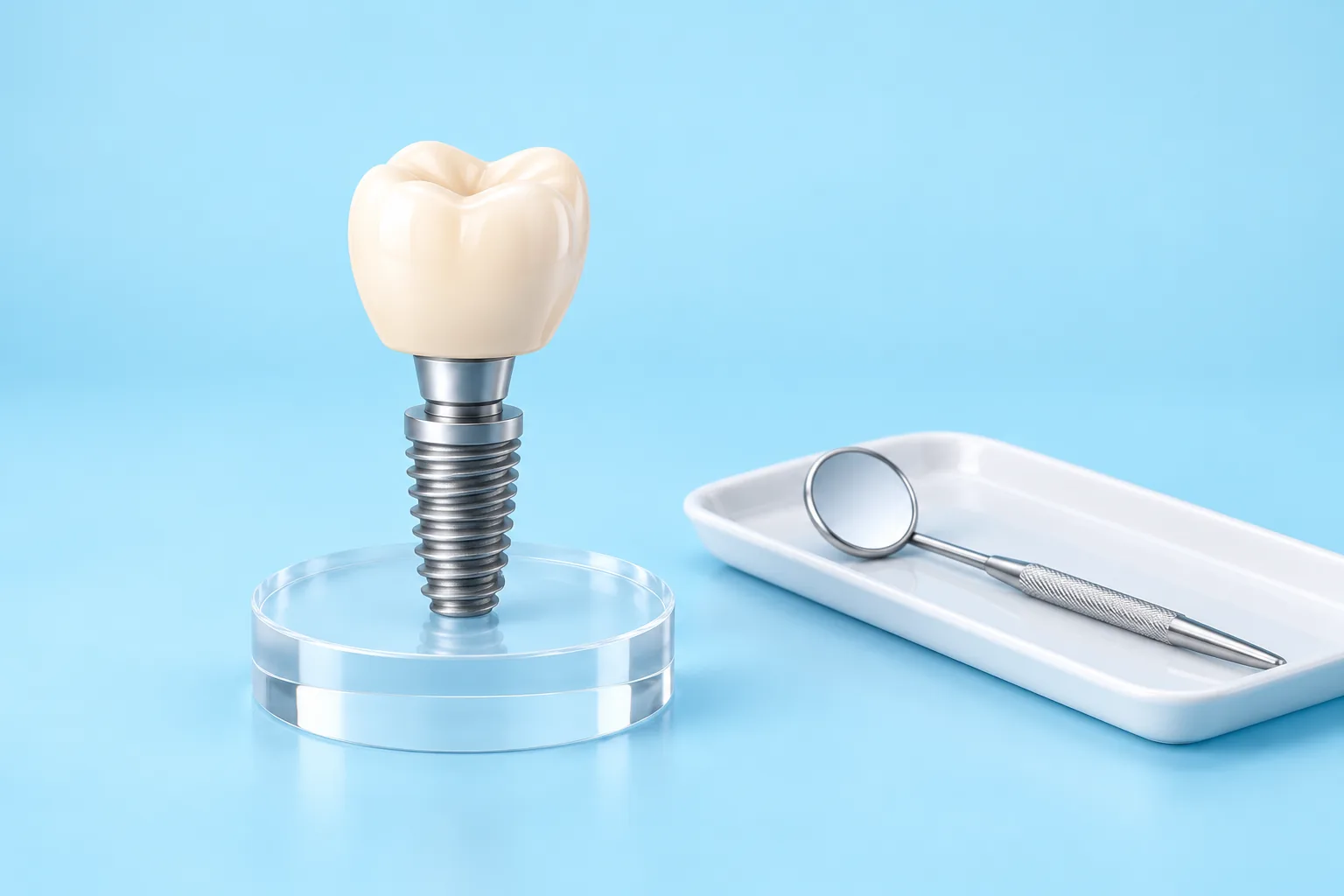
Patients often say that their implant fell out. The implant itself may still be in the bone, while a part on top of it has come loose. It can be one of these parts:
- the crown, which is the visible artificial tooth;
- the abutment, which is the connector between the implant and the crown;
- the small screw that holds the crown or the abutment;
- the healing cap, which is a small cap that shapes the gum before the crown is made.
If one of these parts comes out, follow these steps:
- Keep the part and bring it with you to the dentist.
- Avoid chewing on that side.
- Do not try to put the part back yourself or fix it with glue.
- Contact the clinic and describe what happened.
Our page on emergency dental care in Abu Dhabi gives the same advice for a crown that has come out.
Sometimes the whole implant comes out together with the crown. In this case, you need an examination. The dentist decides what to do next after looking at an X-ray or a scan.
Signs that need a dentist
Please contact a dentist if you notice any of these signs:
- the implant or the crown on it feels loose or moves;
- it hurts when you bite or chew on the implant;
- the gum around the implant is swollen or releases pus;
- the gum around the implant bleeds;
- the metal of the implant has become visible;
- a crown, screw or other part has come out.
When to go to a hospital. Seek immediate hospital care if you have difficulty breathing, speaking or swallowing, severe mouth swelling, or a swollen or painful eye. These warning signs need emergency assessment, whether or not a dental clinic is open.
How to contact us. True Smile is open Monday to Saturday from 10:00 to 20:00 and on Sunday from 10:00 to 18:00. We are not a 24-hour clinic. You can call us on +971 2 550 2900 or write on WhatsApp at +971 50 416 2866. Please describe the problem, and our team will look for the earliest available time.
How a dentist checks a problem implant
A visit starts with an examination. The dentist looks at the gum around the implant, checks whether the implant or the crown moves, and asks when the problem started.
The dentist decides which images are needed. A dental X-ray shows the bone level next to the implant. A CBCT scan shows the bone in 3D. You can read more about how a dental CT scan is done. At True Smile, a complete examination costs 300–400 AED, and a CBCT scan of both jaws costs 700 AED.
The treatment depends on what the dentist finds. General options include professional cleaning around the implant, gum treatment and, in selected cases, surgery. The European Federation of Periodontology describes these approaches. Surgery may include bone grafting, but it cannot guarantee that lost bone will be restored. If a part of the crown is loose or broken, it can sometimes be replaced. In some cases, the implant has to be removed, and a new one is discussed after the area heals. The dentist considers the cause, the remaining bone and your health before recommending treatment.
True Smile has a page explaining its second opinion service. Before booking, ask the team whether your particular implant problem can be assessed. Any existing X-rays, scans and treatment records can help the dentist understand your history.
How to lower the risk of late problems
Good daily care and regular visits lower the risk of problems around an implant.
- Clean around the implant every day, as carefully as around your natural teeth.
- Visit a periodontist or a hygienist every 6 months for a check-up and professional teeth cleaning. Our post-implant guide gives the same interval.
- If you smoke, it is worth talking to your doctor about cutting down or stopping.
- If you have diabetes, keep it under control with your doctor.
- If your dentist has made you a night guard for teeth grinding, wear it as advised.
A dentist makes the diagnosis
This article can help you notice a warning sign early. It cannot replace an examination. Only a dentist can find the exact cause of the problem and suggest a treatment plan after an examination and an X-ray.
If something about your implant worries you, please book a consultation with 3D treatment planning or write to us on WhatsApp.
FAQ
Can a dental implant fail after 10 years?
An implant can fail after 10 years. The Bern study reported implant loss of 1.2% at 10 years and 6.0% at 25 years. These figures describe that study cohort and do not predict the outcome for your implant. A dentist can check for inflammation, bone loss and other causes of a problem.
What does an infected dental implant look like?
Inflammation around an implant may cause red, swollen gum or bleeding when you brush. There may also be pus, a bad taste, pain or visible metal at the gum line. These signs do not always mean an infection, so a dentist needs to examine the implant and take an X-ray.
What should I do if my implant crown falls out?
If your implant crown falls out, keep it and bring it to the dentist. Avoid chewing on that side, and do not put the crown back or glue it yourself. The implant itself may still be in the bone, but a dentist needs to check it. Contact the clinic and describe what happened.
Can bone loss around an implant be treated?
Bone loss around an implant can be treated in some cases. The options depend on how much bone is lost and whether there is still inflammation. A dentist may discuss gum treatment, cleaning around the implant or surgery to rebuild the bone. The dentist chooses the treatment after an examination and an X-ray. Treatment cannot guarantee that lost bone will be restored.
Can a failed implant be replaced?
A dentist may consider another implant after a failed implant is removed. The FDA patient guide explains that implant failure can lead to further surgery to repair or replace the system. Replacement is not suitable for every patient, and the dentist decides when it could be considered. Whether this is possible depends on the amount of bone left and on your general health. Some patients first need bone grafting. A dentist can say what is possible only after an examination and a scan.
Is a loose implant an emergency?
A loose implant or crown needs prompt dental assessment. Please contact the clinic and avoid chewing on that side. Seek immediate hospital care for difficulty breathing, speaking or swallowing, severe mouth swelling, or a swollen or painful eye.
Sources
- Berglundh T, Armitage G, Araujo MG, et al. Peri-implant diseases and conditions: Consensus report of workgroup 4 of the 2017 World Workshop on the Classification of Periodontal and Peri-Implant Diseases and Conditions. Journal of Clinical Periodontology, 2018. https://pubmed.ncbi.nlm.nih.gov/29926491/
- Renvert S, Persson GR, Pirih FQ, Camargo PM. Peri-implant health, peri-implant mucositis, and peri-implantitis: Case definitions and diagnostic considerations. Journal of Clinical Periodontology, 2018. https://pubmed.ncbi.nlm.nih.gov/29926496/
- Howe MS, Keys W, Richards D. Long-term (10-year) dental implant survival: A systematic review and sensitivity meta-analysis. Journal of Dentistry, 2019. https://pubmed.ncbi.nlm.nih.gov/30904559/
- Couso-Queiruga E, Roccuzzo A, Raabe C, et al. Long-Term Incidence of Peri-Implant Conditions: 25-Year Results of The Bernese Prospective Cohort Study. Clinical Implant Dentistry and Related Research, 2026. https://pmc.ncbi.nlm.nih.gov/articles/PMC13348018/
- Derks J, Tomasi C. Peri-implant health and disease. A systematic review of current epidemiology. Journal of Clinical Periodontology, 2015. https://pubmed.ncbi.nlm.nih.gov/25495683/
- European Federation of Periodontology. Peri-implant disease: Treatment. https://www.efp.org/for-patients/dental-implants/peri-implant-disease-treatment/
- NHS. Dental abscess. Hospital warning signs. https://www.nhs.uk/conditions/dental-abscess/
- US Food and Drug Administration. Dental Implants: What You Should Know. https://www.fda.gov/medical-devices/dental-devices/dental-implants-what-you-should-know