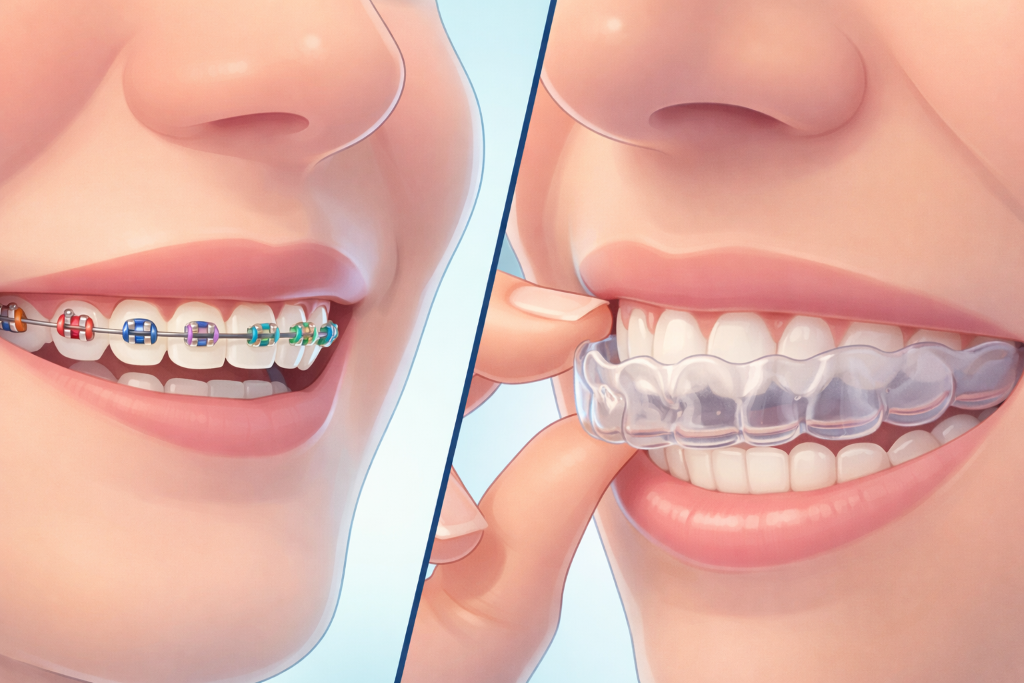
Who Each Option Is For: Matching Treatment to Your Dental Needs
Not all orthodontic problems are the same. Some people have just a little crowding—a few teeth that overlap slightly. Others have more complex issues with how their upper and lower jaws fit together. Because every situation is unique, the right treatment depends on what’s really going on with your teeth and bite. Here’s a simple breakdown of who typically benefits most from each option.
When Braces Are the Preferred Choice
- Your case is more complex. If you have a significant overbite, underbite, or severely crooked teeth, braces give your orthodontist maximum control to guide teeth into the right position.
- You’re still growing. For teenagers whose jaws are still developing, braces (sometimes with additional appliances) can help guide jaw growth, not just straighten teeth.
- You want a “set it and forget it” approach. Because braces are fixed to your teeth, they’re working around the clock. There’s nothing to take out or remember to put back in.
When Clear Aligners Are Most Suitable
- Your issues are mild to moderate. Think small gaps, minor crowding, or slightly rotated teeth. Aligners are very effective at handling these situations.
- You value discretion. If you’d prefer that people don’t notice you’re straightening your teeth, the nearly invisible design of aligners is a major advantage—especially in professional or social settings.
- You’re good at following instructions. Aligners only work if you wear them consistently (20–22 hours a day). If you’re motivated and can commit to that routine, you’ll see excellent results.
Ultimately, a thorough orthodontic check-up with digital imaging and bite analysis is used to understand which category your smile falls into. Our qualified orthodontists can assess your specific anatomy and recommend the most effective approach.
Pros, Cons and Lifestyle Considerations
Beyond clinical effectiveness, your daily habits and personal preferences play a major role in which treatment will feel the most comfortable. Let’s examine how each option fits into real life.
Living with Braces
- Choosing braces means accepting some temporary adjustments to your routine:
- Dietary modifications: You’ll need to steer clear of sticky sweets, hard nuts, and chewy breads that could damage brackets or bend wires.
- Oral hygiene effort: Cleaning around brackets requires extra time and tools like interdental brushes and floss threaders to prevent plaque accumulation and white spot lesions.
- Awareness of appearance: While modern braces are smaller and less conspicuous than in the past, they are still visible. Some patients embrace them as a badge of progress; others feel self-conscious.
On the positive side, braces work continuously without any action required from you. There’s no risk of losing them or forgetting to wear them, and your orthodontist maintains full control over tooth movement at every stage.
Living with Clear Aligners
Opting for aligners offers flexibility but places responsibility squarely on your shoulders:
- No food restrictions: Because you remove aligners before eating, you can enjoy all your favourite dishes—from crunchy samosas to sticky dates—without worry.
- Easy oral hygiene: You brush and floss normally, then simply rinse your aligners and pop them back in. No special techniques needed.
- Almost invisible: Most people won’t notice you’re wearing aligners unless you tell them. This discretion is a major advantage for adults in social and professional settings.
The challenge lies in discipline. Aligners must be worn consistently, and forgetting to reinsert them after meals or snacks can delay your progress. Treatment success depends on your active participation every single day.
Treatment Timelines: What You Can Expect
Timeframes vary based on individual cases, but having a general idea helps set realistic expectations when comparing invisalign vs braces.
Typical Duration with Braces
Traditional braces generally require 18 to 24 months of active treatment. More complex cases involving jaw realignment or multiple tooth extractions may extend to 30 months or longer. Throughout this period, you’ll attend adjustment appointments every 4 to 8 weeks, during which your orthodontist changes wires or adds elastics to maintain steady progress.
Typical Duration with Clear Aligners
For mild to moderate issues, how long aligners take is often shorter, typically between 12 and 18 months. You’ll receive a series of custom-made aligners, each worn for one to two weeks before moving to the next. Orthodontic check-ups are usually scheduled every 6 to 8 weeks to monitor tracking and distribute new sets.
Keep in mind that these timelines depend on you. Aligners must be worn 20–22 hours daily. If you wear them as instructed, you will likely finish on time—or possibly even sooner. If you wear them less often, treatment will take longer. It’s that straightforward.
Cost Factors: What Affects the Price
Orthodontic treatment is a financial investment, and prices in Abu Dhabi vary depending on several key elements:
- Case complexity: Minor adjustments naturally cost less than comprehensive corrections like bite realignment or significant tooth movement.
- Treatment duration: Longer treatment times generally mean more appointments, more materials, and higher overall costs. Complex brace cases often span a longer period than straightforward aligner treatments.
- Technology used: Clinics that employ advanced 3D imaging, digital impressions, and computer‑guided treatment planning invest in equipment that enhances precision. This can influence the final price but often leads to more predictable outcomes.
- Provider expertise: An experienced orthodontist with a track record of successful results brings value beyond simple tooth movement. Their skill in facial aesthetics and bite mechanics ensures your smile is not only straight but also functional and harmonious.
- Brand and materials: Invisalign is a leading aligner brand with extensive research and trained providers, which influences its price. Other aligner brands may cost less. Braces also vary: metal, tooth-coloured ceramic, or lingual (behind the teeth). Aesthetic options typically cost more.
At True Smile, we offer flexible payment plans to make your treatment affordable. During your consultation, we’ll discuss financial options and find a solution that works for your budget.
What to Expect: Appointments, Attachments, and Refinements
The Braces Experience
Your treatment begins with a bonding session where brackets are carefully attached to each tooth and connected by an archwire. This appointment typically lasts about an hour. You may experience mild soreness for a few days afterward as your teeth begin to shift, this is normal and temporary.
Throughout the active phase, you’ll have periodic adjustment visits. Your orthodontist may change wires, add rubber bands for bite correction, or place small springs to address specific issues. Progress is monitored closely to ensure teeth move as planned and you will receive clear aftercare instructions.
Once your teeth have reached their final positions, the braces are removed. Immediately after, impressions or digital scans are taken to fabricate your retainers.
The Aligners Experience
With aligners, your journey starts with a comprehensive assessment, including digital scans of your teeth. Using this data, your orthodontist creates a 3D treatment plan that maps every stage of movement. You can even preview your anticipated final smile before any physical treatment begins.
When your first aligners arrive, you’ll receive several sets along with instructions. Small tooth‑coloured bumps called “attachments” may be bonded to specific teeth. These help the aligners grip more effectively and perform precise movements. Attachments are subtle but crucial for achieving accurate results.
You’ll progress through each aligner at home, switching to the next on schedule. Regular check‑ups (every 6–8 weeks) allow your orthodontist to verify that teeth are tracking as expected. Occasionally, if progress deviates from the plan, “refinements”—additional aligners—may be ordered to fine‑tune the final position. This is a normal part of the process and ensures your outcome meets the high standards set at the beginning.
Retention: The Essential Final Step
It’s important to understand that orthodontic treatment doesn’t truly end when braces come off or the last aligner is worn. The retention phase begins, and it’s just as vital as active treatment.
Teeth have a natural tendency to drift back toward their original positions—a phenomenon called relapse. To prevent this, you’ll need retainers. Whether you’ve worn braces or aligners, retention typically involves:
- Wearing retainers full‑time for the first few months after treatment.
- Transitioning to night‑only wear indefinitely.
- Attending periodic follow‑up appointments to ensure stability.
Your orthodontist will recommend the best retainer for your smile: either clear plastic retainers or a fixed wire behind your teeth. Wearing your retainer is essential. Skip this step, and your teeth can shift back. Commit to retention to protect the smile you’ve worked for.
Frequently Asked Questions
Are clear aligners as effective as braces?
That depends entirely on your teeth. For mild to moderate crowding or small gaps, aligners work just as well as braces. But if your teeth are severely rotated or your bite is significantly off, braces give me more control to get things right.
How long will my treatment take?
Most people wear braces or aligners for somewhere between one and two years. If you just need minor adjustments, we might finish in six months. If we’re doing a full smile makeover, it could be closer to three years.
Do aligners hurt more than braces?
Both involve some discomfort. Your teeth are moving, so they’ll feel tender at times. With braces, you might get some irritation from brackets rubbing against your cheeks. With aligners, you avoid that friction, so many patients find them a bit more comfortable. Either way, any soreness usually fades within a few days.
How many hours a day do I need to wear aligners?
Twenty to twenty-two hours. That means you take them out to eat and to brush your teeth. If you’re tempted to leave them out for a few hours here and there, your treatment will drag on. Wear them consistently, and you’ll stay right on track.
Can I eat whatever I want with aligners?
Yes, with aligners there are no food restrictions at all. With braces, you’d need to avoid sticky or hard foods that could break brackets. So if food freedom matters to you, aligners are a real win.
How often will I need check-ups?
Patients with braces visit their orthodontist every four to eight weeks to make adjustments. With aligners, appointments are usually every six to eight weeks just to check progress and give you your next sets.
Will I need retainers after treatment?
Yes, once your teeth are straight, they’ll try to drift back. Retainers are what keep your smile exactly where we left it. Without them, all that time and effort can slowly undo itself. Our doctors will help you choose the right type and make sure you know exactly how to use it.
Which is better for complex bite problems?
If you have a significant overbite, underbite, or crossbite, braces are usually my first recommendation. They give me the most precision for complicated cases. That said, Invisalign has come a long way, and we can now handle many moderate bite issues with attachments and smart planning.
Your Next Step Toward a Straighter Smile
Choosing between braces and clear aligners is a personal decision that deserves professional guidance. At True Smile Dental Centre, we believe in empowering you with the information you need to make that choice confidently. Our experienced team takes time to understand your goals, examine your dental anatomy, and discuss which pathway aligns with your vision for your smile.
Whether you’re leaning toward the invisible convenience of aligners or the time‑tested reliability of braces, the most important step is simply beginning. Schedule a consultation with us to explore your options, understand the costs involved, and discover what’s possible for your smile in Abu Dhabi.